Coffee Extraction: Why Does Your Coffee Taste Bitter or Sour?

Pawel Horzela
Extraction sounds like a laboratory term, but it’s simply the process of dissolving coffee components in water. This is the moment when water takes over aromas, sugars, and acids from the bean, building the flavor profile in your cup.
Without understanding extraction, brewing coffee is like a roll of the dice – sometimes it turns out great, sometimes terrible, but you rarely know why. Mastering this process is the key that allows you to consciously correct mistakes and repeat your best results.
The Flavor Queue: What comes out first?
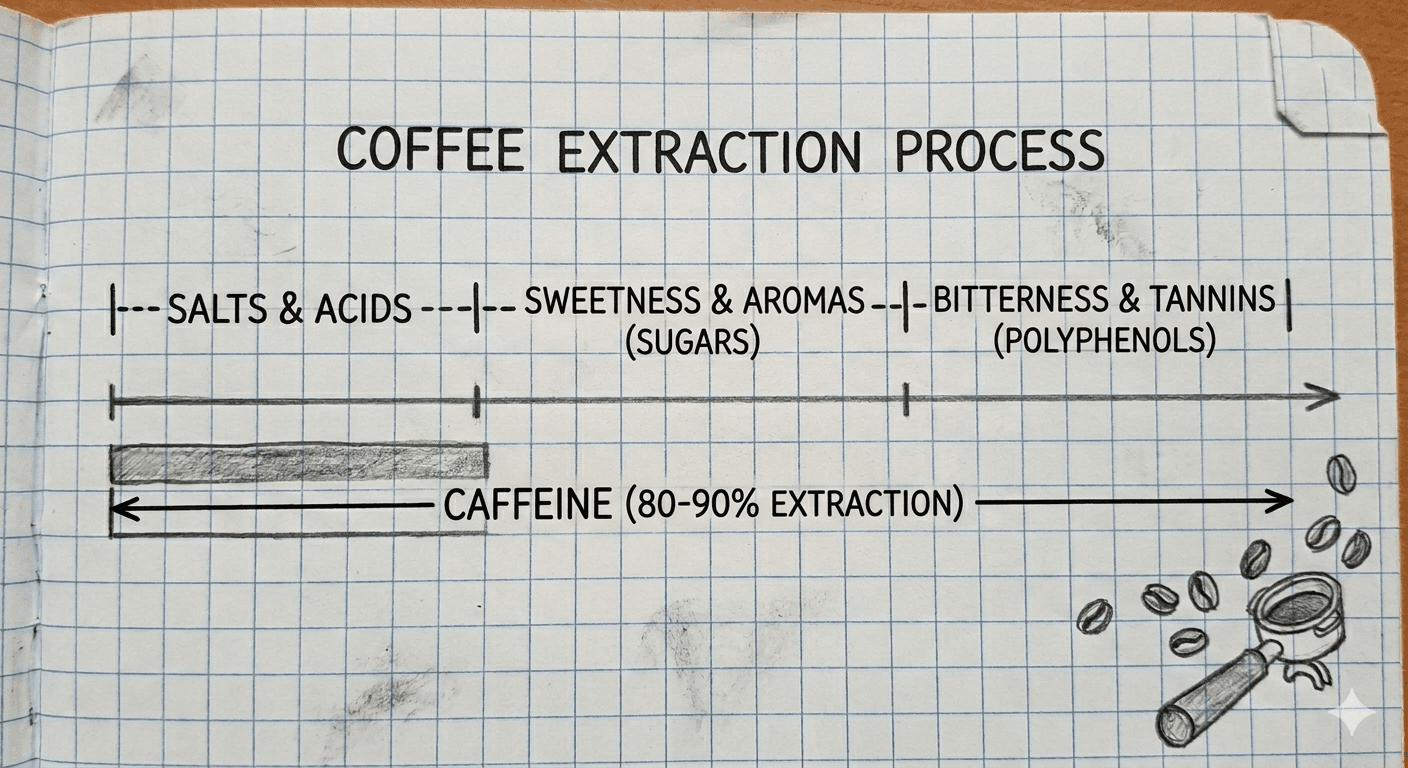
Water doesn't pull everything out at once. Flavors in coffee "stand in a queue," and the brewing time determines how deep into that queue we go. Here is the order:
- First: Acids and Salts. These dissolve the fastest. They give coffee its fruity brightness, but if we stop the process too early, the brew will be aggressively sour, unpleasantly tart, or even salty (as the sweetness hasn't had time to balance them out yet).
- Next: Sugars. This is the "sweet spot." Sweetness appears after a moment, filling the body (texture) of the brew and balancing the initial acidity. This is where the specialty magic happens.
- Finally: Bitterness and Astringency. If the water "tires out" the beans for too long, it starts to wash out heavy organic compounds and polyphenols. The result is a wormwood-like bitterness and a dry sensation on the tongue.
The Caffeine Myth: Many people think that the more bitter and "tar-like" the coffee, the stronger the kick. Wrong! Caffeine is extremely soluble – it hits the cup during the very first phase of brewing. Over-extending the extraction only adds unpleasant bitterness, not real strength.
The Extraction Slider: How to control the flavor?
Imagine you have a slider in your hand. By moving it, you decide how much goodness you extract from the coffee. You can manipulate it using three main parameters:
| Parameter | Higher Extraction (moving toward bitterness) | Lower Extraction (moving toward acidity) |
|---|---|---|
| Grind Size | Finer (larger surface area for water-coffee contact) | Coarser (water flows more freely between particles) |
| Temperature | Higher (water dissolves particles faster and more aggressively) | Lower (the process happens slower and more gently) |
| Contact Time | Longer (e.g., French Press brewed for 4-6 minutes) | Shorter (e.g., a fast, dynamic V60 Drip) |
Diagnostics: How to save your coffee?
Instead of pouring a failed coffee down the sink, treat it as a lesson for tomorrow. Your tongue is the best measuring instrument:
- Does your coffee make you pucker and feel salty? It is under-extracted. Water pulled out the acids and salts, but didn't have enough time to reach the sugars. Next time, grind the beans finer or use hotter water.
- Is your coffee dry, astringent, and ashy? It is over-extracted. Next time, grind the beans coarser, shorten the brewing time, or lower the water temperature by 2-3°C.
💡 Pro Tip: Time is only half the battle
We often hear: "brew V60 for exactly 3 minutes." Remember, however, that time is usually a result of your grind size. If you grind the coffee to dust, water will take a long time to pass through, resulting in a bitter brew. If you grind it like coarse salt, it will flow through instantly, yielding watery acid. Always treat grind size and brewing time as variables that directly influence each other.
Summary
Extraction isn't quantum physics – it's mindful observation. Every cup sends you a signal. If it’s too aggressive – "loosen" the parameters. If it feels immature and too sour – "tighten" them. Understanding this process will stop you from brewing blindly and start you designing your flavor.
Theory is one thing, but how do you fix it in practice? Here is the sweet spot and ways to troubleshoot.
Want to feel the nuances of extraction? Learn how to start sensing more through sensory training.